
Selling at a farmers market looks simple from the shopper's side of the table. From behind it, it is a small retail business that sets up and tears down every week, outdoors, in whatever weather Oregon delivers. This guide covers the order to do things in. It is general information, not legal advice; agencies and individual markets set the actual rules, and they change.
What you sell decides which rules apply
The single most useful thing to figure out first is which category your product falls into. The licensing path, the paperwork and even the market's application questions depend on it.
| You sell | Typical starting point | Who to ask |
|---|---|---|
| Whole, raw produce you grew | Usually no food processing license for that produce | The market manager; ODA if unsure |
| Jams, pickles, dried goods from your own crops | May fall under Oregon's farm direct rules, with limits | Oregon Department of Agriculture |
| Baked goods or other home-kitchen foods | Possibly a domestic kitchen license; some foods are excluded | Oregon Department of Agriculture |
| Hot food or food cooked on site | Temporary or mobile food service license | Your county environmental health office |
| Eggs, meat, dairy | Specific handling, labeling and temperature rules | Oregon Department of Agriculture |
| Crafts and non-food goods | No food license; the market's own rules apply | The market manager |
When an agency tells you a product does not need a license, ask for that answer by email or note the date, name and reference. Market managers sometimes ask, and rules are easier to follow when you can point to exactly what you were told.
Getting the paperwork in the right order
Register the business name
If you sell under any name other than your own legal name, Oregon expects you to register it as an assumed business name with the Secretary of State. It is quick, and it makes opening a business bank account simpler.
Insurance
Many markets require vendors to carry general liability insurance and to provide a certificate naming the market, and sometimes the property owner, as additional insured. Food vendors may also want product liability coverage. Ask the market for its exact wording before you buy a policy.
Scales and selling by weight
A kitchen scale is not legal for trade. If you sell by the pound, you need a commercial scale approved for trade use, and in Oregon it must be licensed through the Oregon Department of Agriculture's weights and measures program. Selling by the bunch, pint or piece avoids the scale question entirely and speeds up the line.
Labels
Anything processed or packaged needs a label. At a minimum that usually means the product name, ingredients in order of weight, net quantity, your business name and location, and major allergens. Specific programs may add requirements, such as statements for home-kitchen foods.
The market application
Most markets accept applications before the season starts and review them for product mix. A market with eight vegetable growers may turn away a ninth and welcome a mushroom grower or a cheesemaker. Read the market's rules on reselling, booth size, attendance and fees before you apply.
Pricing that actually pays you
The most common first-season mistake is pricing to match the grocery store and then discovering the math does not work. Shoppers at a market are paying for freshness, variety and a person they can talk to. Price for that.
Before you set a single price, add up the costs that come with every market day:
- Booth fees, whether a flat rate, a percentage of sales or both.
- Packaging: bags, pint baskets, jars, labels.
- Mileage and fuel for the round trip.
- Hours: harvesting or production, packing, travel, setup, selling, teardown and cleanup.
- Loss: unsold perishables and the inevitable crushed flat.
- Equipment wear: canopy, tables, coolers, card reader fees.
Your first few markets will produce strange numbers. One sells out by ten, the next is rained out. Do not change prices after a single bad day. Track sales by item for at least four market days, then adjust. A notebook with what you brought, what sold and what came home is enough.
Building a booth that sells
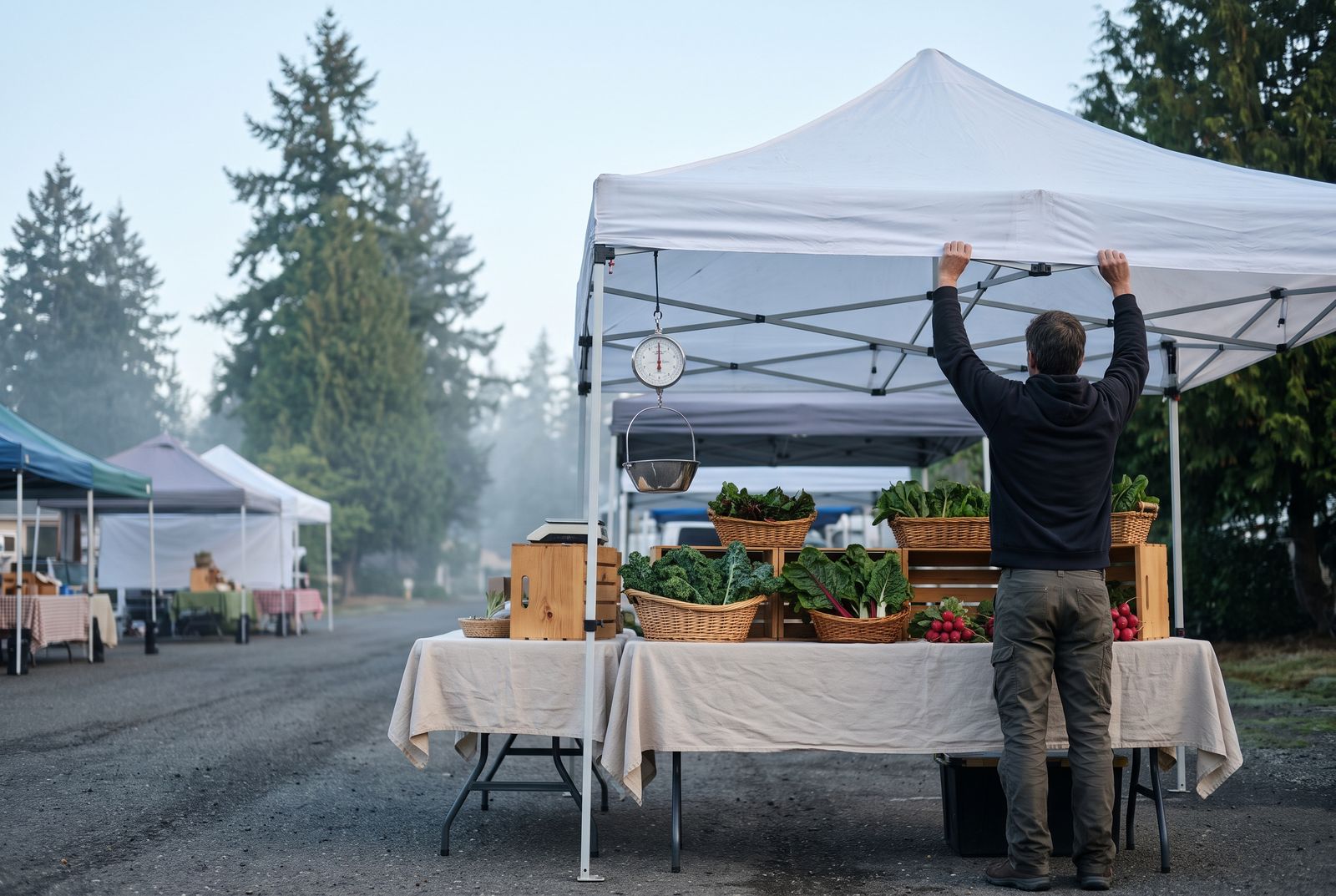
Shoppers decide whether to stop in a few seconds, usually from several stalls away. A few principles help a booth read clearly at that distance.
- Build height. Crates, risers and baskets tilted toward the aisle show more product than a flat table.
- Look abundant. A full basket sells; a half-empty one looks picked over. Use smaller containers late in the day.
- Price everything clearly. Many shoppers will not ask. A chalkboard or clipped tags work.
- Name the variety. "Hood strawberries" or "Bosc pears" invites questions and repeat buyers.
- Leave room to stand. A table pushed to the front of the space gives shoppers somewhere to pause without blocking the aisle.
Weight every canopy leg. Gusts in the Gorge, on the coast and across the high desert can lift an unweighted canopy into the next booth. Many markets set a minimum weight per leg; follow it even on calm mornings.
Market day, start to finish
Shoppers will ask you how to store and cook what they buy. Our guides on storing produce and preserving the harvest are written for exactly those conversations; feel free to send customers to them.
Readiness checklist
Am I ready for my first market?
Tick what is done. Your progress is saved in this browser only and is never sent anywhere.
Vendor questions
Do I need a license to sell vegetables at an Oregon farmers market?
Farmers selling whole, raw produce they grew themselves generally do not need a food processing license for that produce. Processed items, prepared food and products made in a home kitchen are different, and some can be sold under Oregon's farm direct rules or a domestic kitchen license while others need a commercial kitchen. Check with the Oregon Department of Agriculture before selling anything beyond whole produce.
Can I sell jam or baked goods made in my home kitchen?
Possibly. Oregon has routes for some home-produced foods, including farm direct rules for growers who make certain products from their own crops and a domestic kitchen license through the Oregon Department of Agriculture. The rules depend on the product, the ingredients and where it is made, so confirm with ODA before your first market.
Do I need to collect sales tax at Oregon markets?
Oregon has no general state sales tax, so most market sales do not involve collecting one. You still report income on your tax returns, and other taxes or local rules may apply. A tax professional can confirm your situation.
Do I need a special scale?
If you sell by weight, yes. The scale must be suitable for commercial use and, in Oregon, licensed through the Oregon Department of Agriculture weights and measures program. Many new vendors sidestep this by selling by the bunch, basket or piece.
Can I call my produce organic without certification?
Farms with gross organic sales under $5,000 a year can describe products as organic if they follow USDA organic rules, but they cannot use the USDA organic seal. Above that threshold, certification is required to use the word organic. "No spray" or "grown without synthetic pesticides" are descriptions, not certifications, and should be accurate.
No question matches that word. Try a shorter search.