
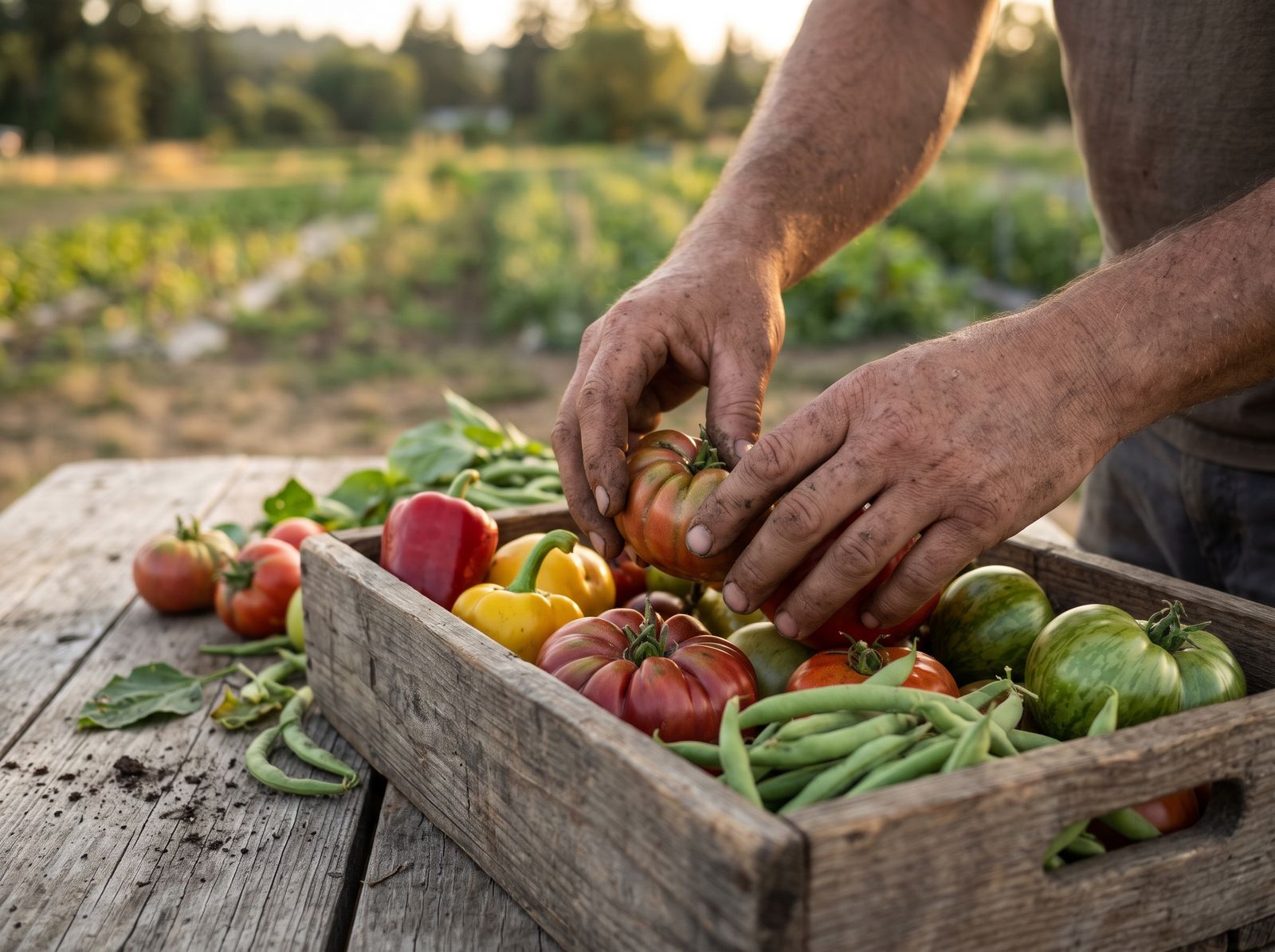
A farmers market rewards a little preparation. The people who come home with the best peaches and the cheapest canning tomatoes are not lucky; they know what time to arrive, what to bring and what to ask. None of it is complicated.
Before you leave the house
Check what is in season this month so you know what to look for and what will not be there. Asparagus in September or tomatoes in May are either from a greenhouse or from somewhere else, and both are worth a question.
- Bring two or three sturdy bags plus one shallow box or basket for berries and soft fruit. Pint baskets crushed under a cabbage are the classic market loss.
- On warm days, leave a cooler with ice packs in the car. Greens, berries and anything from a meat or dairy vendor suffer in a hot trunk.
- Carry some cash in small bills even if you plan to use a card.
- Have a rough plan for the week's meals so you buy for actual dinners. Everything looks good at nine in the morning.
Paying: cash, cards, SNAP and tokens
Payment varies more than most shoppers expect, because every vendor is a separate small business. Plenty of growers take cards on a phone reader. Some do not, and rural markets with poor signal can turn a card-only shopper into a spectator.
Many Oregon markets accept SNAP benefits. The usual setup is a market information booth that swipes your EBT card and hands you tokens to spend at eligible stalls. Some Oregon markets also match SNAP spending through the Double Up Food Bucks program, which effectively stretches benefits on fruit and vegetables. Seasonal Farm Direct Nutrition Program checks for eligible WIC families and seniors are accepted by participating farmers. Each market sets its own arrangements, so confirm at the booth.
Token systems usually cover the whole market, so a vendor without a card reader can still sell to you if the market runs debit or credit tokens. Ask at the information booth before giving up on a cash-only stall.
Walk the whole market once before buying
It is tempting to buy the first beautiful flat of strawberries you see. Resist for ten minutes. A single lap tells you who has the ripest fruit, who has seconds, and whether the stall at the far end has the variety you actually want. It also stops you buying three bunches of kale from three different tables.
Buy heavy, sturdy things first and the fragile things last: potatoes and squash at the start, then greens, then berries and eggs right before you leave.
Reading ripeness without squeezing everything
Market fruit is often picked riper than grocery fruit, which means less margin for rough handling. Most ripeness checks rely on your eyes and nose first.
| Crop | Look for | Pass on |
|---|---|---|
| Strawberries | Red to the shoulders, glossy, fragrant from a short distance | White shoulders, wet or stained basket bottoms |
| Blueberries | Deep blue with a dusty white bloom, no red near the stem | Shriveled berries or juice pooling in the box |
| Peaches | Gold or cream background color with no green, strong smell | Green around the stem, bruises on the shoulders |
| Sweet corn | Tight green husks, moist silk, plump kernels at the tip | Dry, yellowed husks or dented kernels |
| Tomatoes | Full color for the variety, heavy for the size, fragrant stem end | Weeping cracks or soft sunken spots |
| Pears | Firm fruit you will ripen at home; a little give at the neck when ready | Soft around the middle, which means overripe inside |
| Melons | Sweet smell at the stem end, heavy, a creamy ground spot on watermelon | Green ground spot, no smell at all |
Pears are the odd one out: they ripen best off the tree, so a good grower sells them firm. Once they are home, the storage guide explains how to ripen them on the counter and then hold them in the fridge.
Questions that get useful answers from growers
Most growers like talking about their crops, especially when the market is quiet. Specific questions get better answers than general ones.
- When was this picked? Yesterday and this morning are both good answers for most produce. Sweet corn and peas lose sweetness fast.
- Where is your farm? A clear answer with a town name is reassuring. Vague answers deserve a follow-up.
- How do you grow it? Better than asking "is it organic?", because it invites details about spraying, soil and pest control.
- Which variety is this, and what is it good for? Some apples are for eating, some for pie, some for storage. The grower knows which.
- Do you sell seconds or bulk flats? More on this below.
- When does this run out? The only reliable way to know how much time you have left for marionberries or peaches.
Most markets require vendors to sell what they grow or make, with limited exceptions. Some do not, and a few vendors stretch the rules. Watch for produce that is out of season for Oregon, identical sizes and stickers, or wholesale cartons stacked behind the table. None of that proves anything on its own, but it is a good reason to ask where the farm is. Market managers take these questions seriously.
Bulk flats, seconds and canning boxes
If you plan to make jam, sauce or frozen fruit, buying by the flat or box is usually cheaper per pound. Many growers also sell seconds: produce with cosmetic damage, odd shapes or slightly overripe spots that is perfectly good for cooking and preserving.
Seconds are not always on display. Ask, and if a grower does not have them that day, ask whether you can order a box for next week. Plan to process seconds within a day; they do not keep like first-quality fruit. The preserving guide covers what to do with a 20-pound box of tomatoes on a Saturday afternoon.
Market etiquette that growers notice
- Ask before sampling, and do not squeeze soft fruit to test it. Every squeeze is a bruise for the next shopper.
- Haggling is not the norm at most Oregon markets. Asking about a bulk price is fine; negotiating a single bunch of carrots is not.
- Keep dogs on a short leash and away from produce tables, and check the market's pet rules before bringing one.
- If you love something, say so, and come back for it. Regular customers are how small farms plan next season.
The short version
- Check what is in season, bring bags, cash and a cooler.
- Walk the market once, buy sturdy things first and fragile things last.
- Ask when it was picked and where it was grown.
- Ask about seconds if you are preserving.
Questions shoppers ask
Is it better to go to the farmers market early or late?
Early gets you the full selection, which matters for berries, eggs, flowers and anything popular that sells out. Late can mean a grower is willing to sell remaining stock in bulk, but it is not a guarantee and many farmers would rather take produce home than discount it. Go early for specific items and late only when you are flexible.
Do farmers market vendors take cards?
Many do, using phone-based card readers, but not all. Cash in small bills still makes every transaction faster and works when a reader loses signal. If a vendor only takes cash, the market information booth can usually tell you whether there is an ATM or token system nearby.
Can I use SNAP at Oregon farmers markets?
Many Oregon markets accept SNAP, usually by swiping your EBT card at the market booth in exchange for tokens you spend with vendors. Some also match SNAP spending through Double Up Food Bucks. Participation varies by market, so check with the market itself before you go.
What does "no spray" mean if a farm is not certified organic?
It is a claim the grower is making, not a certification. It may be completely accurate. Ask what it means on that farm: no synthetic pesticides, no pesticides at all, or no spraying on that particular crop. Certified organic means the farm follows USDA organic rules and is inspected, though very small farms can follow the rules and sell as organic without certification as long as they do not use the USDA seal.
How do I know if a vendor actually grew what they are selling?
Ask directly and specifically, for example where the farm is and when this was picked. Most markets have rules about reselling and display them at the information booth. Out-of-season produce, perfectly uniform sizes and wholesale boxes behind the table are reasons to ask.
No question matches that word. Try a shorter search.