
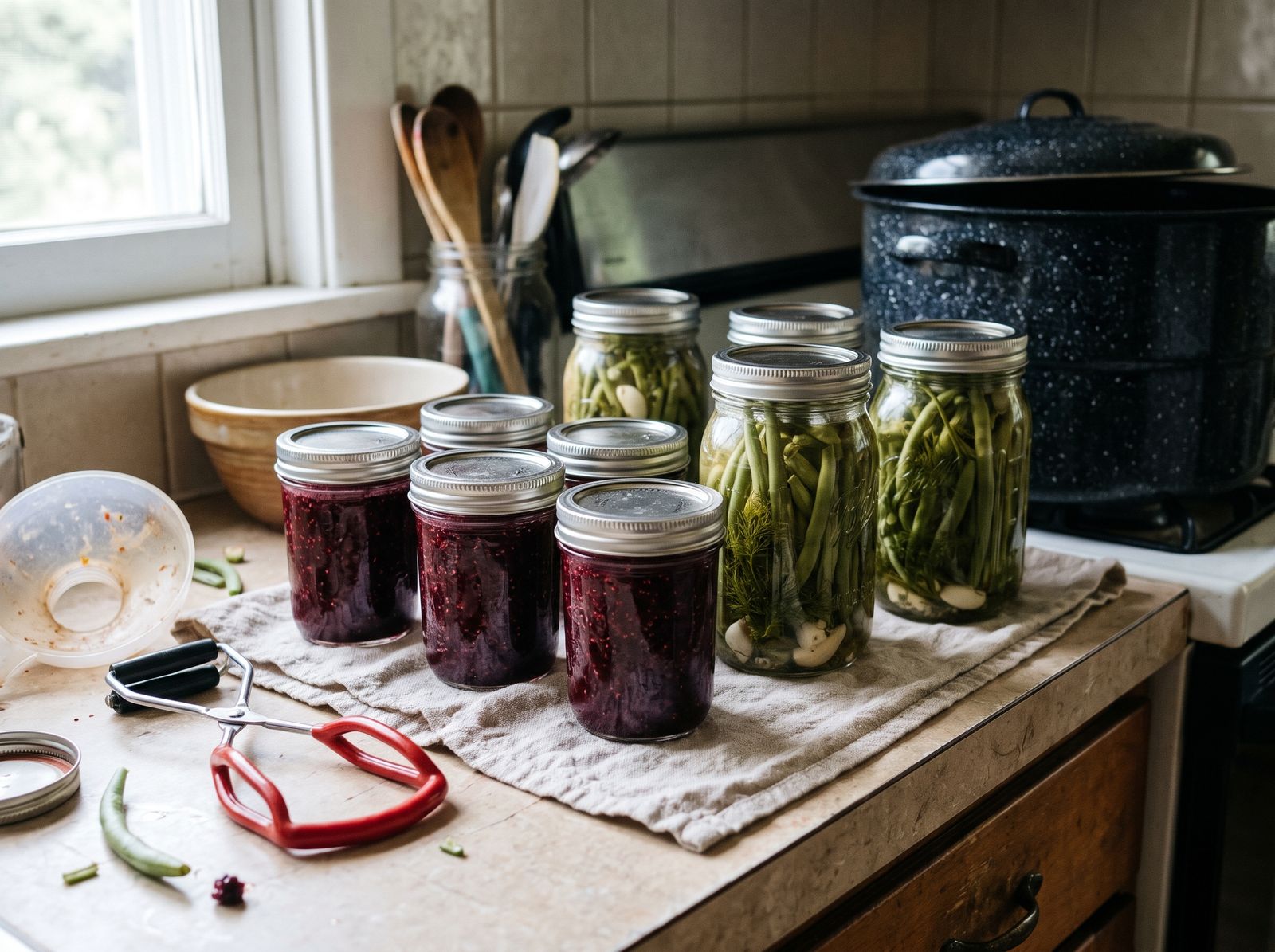
A flat of peaches or a box of tomato seconds is a good problem to have, but only if you have a plan by Saturday afternoon. The method you choose depends on two facts about the food, its acidity and its texture, and one fact about you: how high your kitchen sits above sea level.
This guide is an orientation, not a recipe book. For processing times, follow recipes tested by the USDA, the National Center for Home Food Preservation or Oregon State University Extension. Guessing at times is how safe-looking jars become unsafe ones.
Find the right method for what you bought
Method chooser
Pick the food and your elevation. The answer updates as you choose.
Choose a food to see the recommended method.
Acidity decides which canner you need
Clostridium botulinum spores survive boiling. In a sealed jar of low-acid food, they can grow and produce a toxin without any smell or visible change. Acid stops them, which is why the dividing line in home canning sits at a pH of 4.6.
| Food | Acidity | Method |
|---|---|---|
| Most fruit, jams, jellies | High acid | Boiling water bath |
| Vinegar pickles, relishes | Acidified by the brine | Boiling water bath, tested recipe only |
| Tomatoes | Borderline, acid added | Water bath or pressure, with lemon juice or citric acid |
| Green beans, corn, peas, carrots, potatoes | Low acid | Pressure canner only |
| Soups, stocks, meat | Low acid | Pressure canner only |
Older methods still circulate in family recipe boxes and online videos: oven canning, open-kettle canning, sealing jam with paraffin wax, and water bath canning of plain vegetables. None of these are considered safe. If a recipe does not name a tested source, do not trust its times.
Altitude: the step Oregon cooks skip
Water boils at a lower temperature as elevation rises, so the same processing time delivers less heat. Most of the Willamette Valley, including Portland, Salem and Eugene, sits below 1,000 feet and can use recipe times as written. Much of southern and central Oregon does not. Medford is above 1,000 feet, Bend is around 3,600 and Klamath Falls is above 4,000.
| Elevation | Water bath | Weighted gauge | Dial gauge |
|---|---|---|---|
| 0 to 1,000 ft | Time as written | 10 lb | 11 lb |
| 1,001 to 2,000 ft | Add about 5 minutes | 15 lb | 11 lb |
| 2,001 to 3,000 ft | Add about 5 minutes | 15 lb | 12 lb |
| 3,001 to 4,000 ft | Add about 10 minutes | 15 lb | 12 lb |
| 4,001 to 6,000 ft | Add about 10 minutes | 15 lb | 13 lb |
Some recipes use different water bath increments, so the recipe's own altitude chart always wins. Not sure of your elevation? Search your address on a topographic map or the USGS elevation tools, and round up when in doubt.
Freezing: the easiest method for most vegetables
Freezing keeps more fresh flavor than canning for many crops and needs no special equipment. Most vegetables should be blanched first: a short boil followed by an ice bath. Blanching stops the enzymes that otherwise turn frozen vegetables dull, tough and off-tasting within a few months.
- Green beans: about 3 minutes in boiling water, then ice water for the same time.
- Broccoli florets: about 3 minutes.
- Peas: about 1 1/2 minutes.
- Kale and chard: about 2 minutes, squeezed dry before bagging.
- Sweet corn kernels: blanch whole ears about 4 minutes, cool, then cut off the kernels.
Berries need no blanching. Spread them unwashed or washed-and-dried on a sheet pan, freeze until hard, then bag. They stay loose, so you can pour out a cupful at a time. Peaches keep their color better with a little ascorbic acid or lemon juice. Press out as much air as possible from every bag; air is what causes freezer burn.
Drying fruit and herbs
A dehydrator gives the most consistent results. Fruit generally dries at around 135 degrees Fahrenheit, and herbs at much lower temperatures to keep their oils. Apples, pears and plums dry well in western Oregon kitchens; tomatoes do too, though they take a long time. Pretreating light-colored fruit with lemon juice or ascorbic acid limits browning.
Dried fruit should feel leathery, with no beads of moisture when you tear a piece. Condition it before long-term storage: pack it loosely in a jar for a week and shake daily. If condensation shows up, it needs more drying.
When a batch goes wrong
Even careful canners have jars that do not seal or jam that will not set. Knowing the fix saves the batch.
The bottom line
- High-acid foods can go in a water bath; low-acid foods need a pressure canner or the freezer.
- Add acid to every jar of tomatoes.
- Above 1,000 feet, adjust time or pressure. That covers much of southern and central Oregon.
- Use tested recipes and get dial gauges checked every year.
Buying for a big preserving weekend? The harvest calendar shows when each crop peaks, and the shopping guide explains how to ask growers for canning boxes and seconds.
Preserving questions
Can I can green beans in a water bath canner?
No. Green beans and other plain vegetables are low-acid foods, and a boiling water bath does not reach the temperature needed to destroy botulism spores. Use a pressure canner with a tested recipe, or blanch and freeze them.
Do I need to adjust canning times in Bend?
Yes. Bend sits at roughly 3,600 feet. Water bath recipes typically need about 10 extra minutes in the 3,001 to 6,000 foot range, and pressure canning there calls for 15 pounds on a weighted gauge or 12 pounds on a dial gauge up to 4,000 feet. Always check the altitude chart in your tested recipe.
Why add lemon juice to tomatoes?
Some tomatoes are close to the acidity line that separates water-bath-safe foods from low-acid foods. Adding bottled lemon juice or citric acid to each jar brings every batch into a safe range regardless of variety. Bottled juice is used because fresh lemons vary in acidity.
How often should a pressure canner gauge be tested?
Dial gauges should be checked for accuracy every year before canning season. Many county Extension offices test them; call ahead. Weighted gauges do not drift the same way, but the gasket and vent should still be inspected.
Is it safe to use old family canning recipes?
Treat them with caution. Methods like oven canning, open-kettle canning, paraffin-sealed jam and water bath canning of vegetables were once common and are not considered safe today. Use recipes tested by the USDA, the National Center for Home Food Preservation or a university Extension service.
No question matches that word. Try a shorter search.